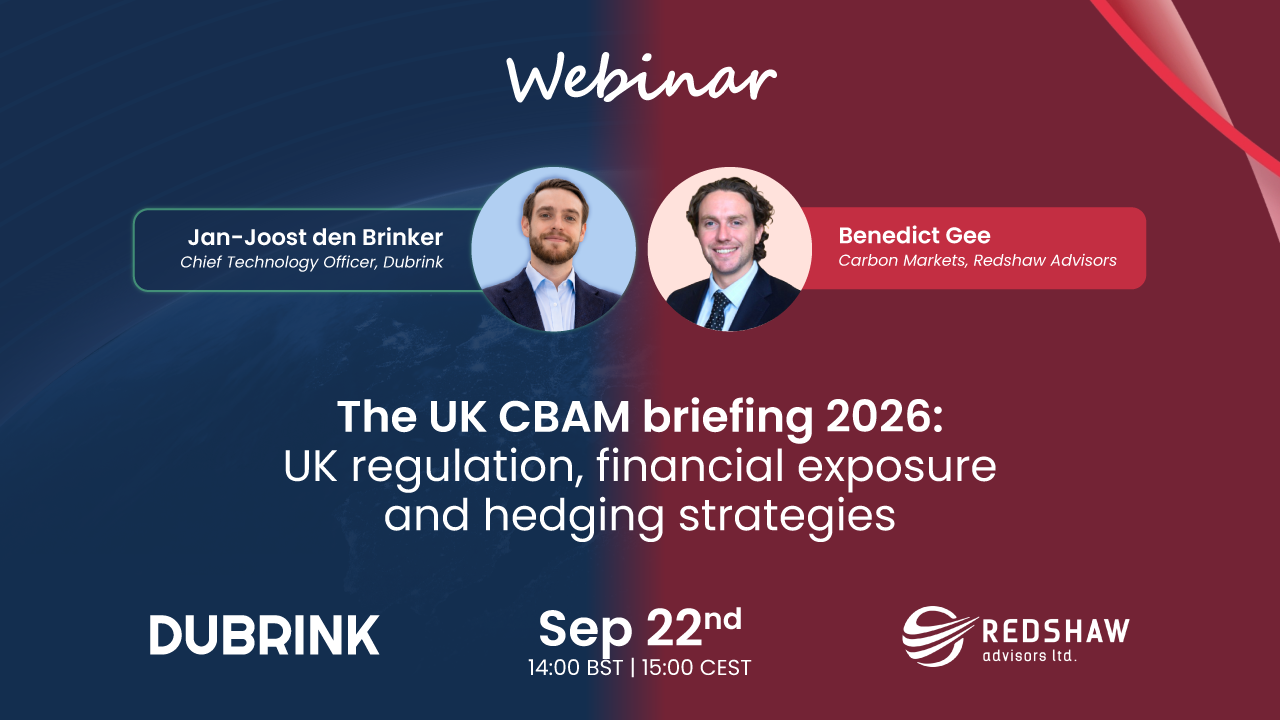

The UK Carbon Border Adjustment Mechanism will enter into force on 1 January 2027. For importers of aluminium, cement, fertilisers, hydrogen, and iron and steel, the time to prepare is now.
Join Redshaw Advisors and Dubrink for a practical webinar combining regulatory guidance with financial risk management. We will explain how UK CBAM is expected to work, share our market insights so far, and explore how companies can manage and hedge their future CBAM exposure.
During this session:
Jan-Joost den Brinker, Co-founder of Dubrink and Vice-President of IACBAM, will explain the scope, calculation methodology, reporting requirements, and practical implications of UK CBAM.
Benedict Gee of Redshaw Advisors will examine the financial risks created by carbon-price volatility and explain how importers can use hedging strategies to gain greater control over their future CBAM costs.
Understanding and preparing for UK CBAM
We will cover:
The latest UK CBAM developments and what they mean in practice
Dubrink’s insights from discussions with importers, manufacturers, customs specialists, and international suppliers
Which companies and imported goods are expected to fall within scope
The most important differences between UK CBAM and EU CBAM
How UK CBAM liabilities are expected to be calculated
What importers will need from their non-UK suppliers
Where companies are most likely to encounter data gaps, calculation difficulties, and unexpected costs
Common misconceptions and risks that companies may currently be underestimating
Practical steps that importers can already take before UK CBAM takes effect
Tips for mapping imports, engaging suppliers, improving data availability, and forecasting future exposure
Our recommendations for building a proportionate and effective UK CBAM preparation plan
Understanding and hedging your financial exposure
UK CBAM will not only create a compliance obligation. It will also expose importers to fluctuating carbon prices, potentially affecting purchasing costs, margins, pricing decisions, and commercial contracts.
Redshaw Advisors will explain:
How UK carbon-price movements could affect future CBAM liabilities
Why waiting until the payment obligation arises may leave companies financially exposed
The relationship between procurement decisions, delivery dates, carbon prices, and CBAM exposure
How carbon-price volatility can affect budgets, margins, and customer pricing
The different approaches companies can consider when managing or hedging their exposure
How hedging can provide greater cost certainty and protect commercial margins
When a company should consider starting its hedging preparations
Which internal teams should be involved in a CBAM hedging strategy
Practical tips for integrating CBAM exposure into procurement, finance, and risk-management processes
This will not be a purely legal or theoretical presentation. Dubrink and Redshaw Advisors will share practical insights, tips, and recommendations based on what they are currently seeing in the market and the preparations already being made by affected companies.
The webinar is designed for importers, manufacturers, customs specialists, logistics providers, finance teams, procurement teams, risk managers, and sustainability professionals who need a clear and commercially relevant understanding of UK CBAM.
Participants will also have the opportunity to submit questions directly to the speakers.
Date: 22 September 2026
Time: 14:00 BST | 15:00 CEST
Duration: Approximately 60 minutes
Participation: Free of charge
Dubrink and Redshaw Advisors will also be present at the UK Metals Expo on 4–5 November 2026, where visitors can meet CBAM specialists at the Dubrink CBAM Information Point.