CBAM for goods moving into the EEZ and continental shelf
CBAM expands offshore. New rules for EEZ & continental shelf operators. Understand your new importer obligations, declarations, and how Dubrink ensures compliance.
A new EU Implementing Regulation now extends CBAM obligations to goods moved into the Exclusive Economic Zones (EEZ) and continental shelves of EU Member States. These changes directly impact offshore operators, energy producers, and any business supplying equipment or materials to installations beyond the EU’s traditional customs territory.
This article breaks down the new definitions, clarifies who is now considered the "importer," and details the new declarations required.
Why this change matters
The new regulation clarifies that CBAM obligations apply beyond the EU's land-based customs territory.
Operators active in wind parks, offshore platforms, and other EEZ installations may now be treated as importers under CBAM. This is the crucial part: these obligations apply even when goods never pass through a traditional EU customs point.
This creates new reporting duties, introduces new declarations, and, for many operators, establishes an urgent need to become an Authorized CBAM Declarant.
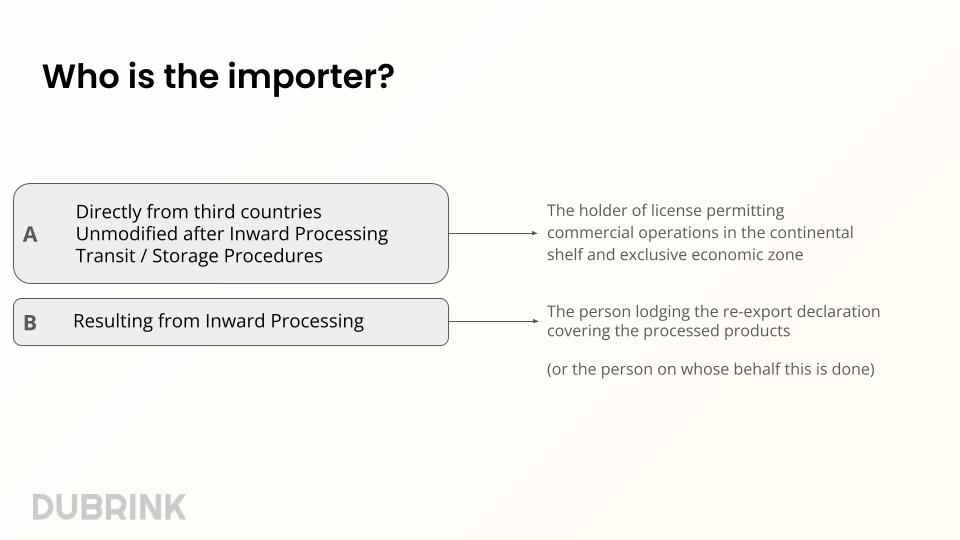
Who is the importer?
The regulation draws a clear distinction based on the movement and processing status of goods.
Scenario A: Direct arrival into the EEZ
This includes:
Goods coming directly from a third country into an EEZ or continental shelf.
Goods moved from the EU into the EEZ without modification.
Goods leaving a transit or storage procedure and moving into the EEZ.
Importer under CBAM: The holder of the license for the EEZ installation (e.g., the wind park operator).
Key takeaway: Even though no customs declaration is lodged (because the EEZ is outside the customs territory), the operator assumes full responsibility for CBAM compliance.
Scenario B: Goods that underwent Inward Processing
This applies if goods are:
Processed under the inward processing procedure inside the EU, and
Then moved into the EEZ.
Importer under CBAM: The person lodging the re-export declaration, or the person on whose behalf that declaration is lodged.
Key takeaway: In this case, the CBAM obligation is tied to the customs procedure already in place for processing the goods.
What triggers CBAM?
Because these CBAM obligations apply outside the traditional customs territory, the EU created two mechanisms to capture the necessary data which function as the trigger for the CBAM obligations.
Receipt Declaration (Scenario A)
This is a new, simplified "mini customs declaration."
What it is: A new declaration that must be filed every time applicable goods arrive in an EEZ. It is submitted to the Member State that "owns" that EEZ.
Example: A floating platform is shipped from Turkey to a Dutch offshore wind park. The Dutch license holder must file the Receipt Declaration with Dutch Customs.
What it includes: The declaration requires basic entity details, receipt information, coordinates of the installation, and commodity details (CN code, weight, description).
How to file: It can be filed electronically or by email, though email submissions face significant delays due to manual processing. Dubrink allows you to generate digital receipts declarations that can be electronically submitted to the relevant Customs Authority.
Bill of Discharge (Scenario B)
For goods exiting inward processing, the Bill of Discharge triggers the CBAM obligation.
What it is: This document already exists within the inward processing framework.
How it works: It contains the CBAM account number used to determine responsibility. This document must be filed for every applicable movement, just like a standard customs declaration.
What are the implications?
If you operate on the continental shelf or within a Member State’s EEZ:
You may now be legally considered an importer under CBAM
You may need to register as an Authorized Declarant under CBAM
You may need to file receipt declarations for every arrival of goods
Your re-export declarations may now trigger CBAM obligations
For wind parks, offshore energy operators, EPC contractors, service vessels, and suppliers, these rules create a direct compliance obligation where none existed before.
How Dubrink helps
These changes are highly technical, and determining whether Scenario A or Scenario B applies is not always straightforward. We can help you with:
Determining importer responsibility
Assessing CBAM exposure for offshore operations
Helping you obtain the Authorized Declarant status
Monthly Receipt Declarations and annual CBAM Declarations
Full operational compliance for EEZ and continental shelf movements
If you operate offshore or supply goods to EEZ installations, your obligations may have changed overnight. We can help you understand exactly what applies. Visit dubrink.com/meet to get in touch.